Walk right into any work environment, sports club, or café in Osborne Park and you will certainly listen to a mix of good purposes and negative information about first aid. Individuals care, they intend to help, yet a lot of what they think they understand originates from flicks, social media sites, or half-remembered college lessons. I see it every week when I instruct emergency treatment and CPR training in Osborne Park. Positive people doing the incorrect point, and quiet people who could absolutely assist but hold back as a result of myths that scare them.
Getting emergency treatment right is not regarding coming to be a hero. It has to do with recognizing a couple of core facts, going down the obsolete concepts, and sensation certain enough to act. The distinction in between a misconception and the real truths can be the difference in between a good outcome and a very negative day.
Below are one of the most common myths I hear in Osborne Park emergency treatment courses, in addition to the evidence-based reality and some functional advice you can really use.
Myth 1: "CPR is only for medical professionals"
I hear this at practically every CPR training Osborne Park session. Somebody states, quietly, that they will possibly still await the rescue due to the fact that they are "not qualified sufficient" to begin CPR.
The truth is straightforward and candid. If an individual is not taking a breath typically and has no signs of life, every minute without CPR cuts their possibility of survival by approximately 7 to 10 percent. Paramedics in Perth and Osborne Park are extremely skilled, but they still require time to reach you. Those initial few mins belong to bystanders.
Modern mouth-to-mouth resuscitation training courses in Osborne Park are made around that fact. You do not require to be a registered nurse, a physio, or a fitness center instructor to provide reliable CPR. You simply need:
Recognition that something is wrong. The willingness to start compressions. The standard strategy, which can be learned and rejuvenated regularly.When I run a first aid and mouth-to-mouth resuscitation program in Osborne Park, I see individuals who have never done any health and wellness training become proficient in a mid-day. They leave with an emergency treatment certificate Osborne Park companies acknowledge, yet a lot more importantly, they leave prepared to place hands on a chest and begin compressions without awaiting a person "extra qualified".
Fact: High quality bystander mouth-to-mouth resuscitation from normal people is one of the best forecasters of survival in heart attack. Waiting for a professional can cost a life.
Myth 2: "You will certainly break ribs, so much better not to do mouth-to-mouth resuscitation"
This is the 2nd greatest fear in CPR courses Osborne Park large. Individuals worry, occasionally intensely, that they will "crack the person's upper body" and be sued.
Here is the fact from years of practice and training: rib or cartilage injuries can happen throughout CPR, specifically in older grownups. They are not a sign of you doing it severely, they are a sign that you are pressing hard enough to distribute blood. It seems extreme, and it can really feel confronting the very first time you feel or hear a "click" under your hands, yet damaged ribs can heal. A stopped heart does not.

You are not intending to damage bones. You are going for firm, balanced compressions about one third of the depth of the chest, at around 100 to 120 compressions per min. In reality, when the adrenaline is valid first aid certification pumping, many individuals do not press hard sufficient. The anxiety of causing pain or damage holds them back, despite the fact that the individual in heart attack is subconscious and can not really feel it.
In a great CPR course Osborne Park participants method on manikins that give feedback on depth and rate. After a couple of rounds, most people are amazed at exactly how difficult they really require to push. Once they have that physical memory, the worry about ribs goes down sharply.
Fact: Minor breast injuries are a well-known and acceptable threat of mouth-to-mouth resuscitation. The danger of not doing mouth-to-mouth resuscitation is death.
Myth 3: "If I aid and something goes wrong, I'll be taken legal action against"
Legal anxiety maintains good individuals frozen. In nearly every Osborne Park first aid training session, someone asks about "entering difficulty" for attempting to help.
Australia has what are usually referred to as "Good Samaritan" defenses. The exact phrasing differs by state, yet the basic idea is consistent. If you give first aid in good confidence, act sensibly within your degree of training, and do not behave recklessly or intoxicated, the regulation gets on your side.
That suggests if you have actually done a first aid course in Osborne Park and you make use of those skills to assist a person broke down on Main Road, you are doing exactly what the regulation and neighborhood anticipate of you. You are not committing to hospital-level care. You are getting time: opening a respiratory tract, starting mouth-to-mouth resuscitation, making use of an AED if available.
What the law will certainly not secure is intentionally dangerous or extremely unsuitable practices. If you determine to "try out" a neck adjustment you saw on a feat video clip, that is not first aid. If you drag a person about when they are clearly secure to leave in place, that is not practical care. Sound judgment still applies.
First Aid Pro Osborne Park and various other credible service providers cover this legal side thoroughly in class, since once people understand it, you can virtually feel the room relax. They know they have permission to act.
Fact: In Australia, a well intentioned onlooker supplying practical first aid is extremely not likely to deal with legal action, and far more likely to be thanked.
Myth 4: "The recovery placement is only for individuals who are unconscious"
The recovery placement is an effective tool, however badly misunderstood. I consistently see people leave a first aid and CPR course Osborne Park wide believing they only utilize it when someone is totally unresponsive.
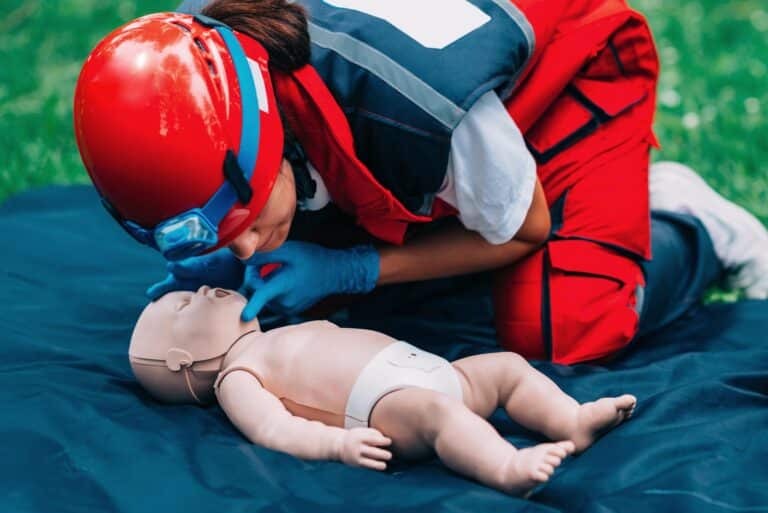
In fact, you consider the recovery position whenever an individual can not accurately safeguard their own air passage. That consists of somebody that is semi conscious, really drowsy from alcohol, or in the onset of a seizure or diabetic emergency where they drift in and out.
If someone is pushing their back and vomits or their tongue drops back, their air passage can obstruct promptly and quietly. Moving them carefully onto their side, with the head slightly slanted and the mouth angled down, lets liquid drain out, keeps the respiratory tract clearer, and acquires you time until help arrives.
There are compromise. If you think a significant neck or back injury, such as after a high speed automobile crash, you prioritise keeping the head and neck aligned and only move the person if there is instant risk like fire or website traffic. That is why useful, situation based emergency treatment courses in Osborne Park issue. You need to learn the judgment, not simply the book answers.
Fact: The recovery setting is for anyone that can not accurately keep their respiratory tract clear, not simply those that are fully unconscious.
Myth 5: "If somebody is choking, hit them on the back while they are standing upright"
This one is so typical that even well meaning personnel in restaurants and workplaces do it. Person starts choking, another person backs up and begins slapping hard between the shoulder blades while the casualty is bolted upright, shoulders tense.
The back strikes themselves are proper. The posture usually is not.
When someone has an extreme air passage obstruction and can not cough or speak effectively, back strikes should be forceful and guided somewhat upward between the shoulder blades. You want gravity helping you, not antagonizing you. That is why emergency treatment training in Osborne Park and somewhere else educates you to lean the person forward, support their upper body with your hand, and then provide the blows.
If that does not work, you move to stomach thrusts where qualified and allowed, or chest drives, relying on the guidelines you follow and the course content. There is subtlety here for expecting individuals, babies, and larger casualties, and you require to practice this in a monitored setting before trying it in genuine life.
Choking in children is particularly emotionally charged. I have had moms and dads get to emergency treatment courses in Osborne Park still drank months after a near miss out on with a grape or an item of sausage. Once they learn the correct techniques for infants and children, and experiment manikins, you see their pose modification. They go out taller, whether they have an official first aid certificate Osborne Park companies require or they are simply there as mums and dads.
Fact: For serious choking, lean the individual ahead for back blows so gravity helps you, and utilize methods particular to the individual's age and condition as covered in a high quality first aid course.
Myth 6: "Cardiovascular disease and heart attack are the same thing"
This is greater than a vocabulary problem. Confusing both bring about hold-ups in calling a rescue or beginning CPR.
A heart attack is generally a circulation problem. Blood circulation to component of the heart muscular tissue is obstructed. The individual is frequently conscious, in pain, clammy, and frightened. They might have chest discomfort, discomfort down the arm or right into the jaw, shortness of breath, or nausea or vomiting. They require urgent clinical attention, however they may not need CPR unless their problem deteriorates.
Cardiac arrest is an electrical issue. The heart quits pumping properly, and the individual collapses, becomes less competent, and is not taking a breath typically. This is when mouth-to-mouth resuscitation and defibrillation are critical.
In Osborne Park first aid training, we hang around on the early indication of cardiovascular disease due to the fact that capturing it early can prevent it toppling into apprehension. We likewise pierce home that if you are unsure whether the person is breathing generally, you treat it as a heart attack and start CPR, as opposed to standing in doubt.
Fact: Heart attack is a blood circulation problem where the person is normally awake. Cardiac arrest is when the heart quits properly and the person breaks down and quits breathing normally. Mouth-to-mouth resuscitation is for cardiac arrest.
Myth 7: "I did a program years back, I still remember it"
Memory does not age well, particularly under anxiety. I have actually seen people who did an emergency treatment and mouth-to-mouth resuscitation course ten years earlier panic throughout simple scenarios on a refresher. They know they learned it when, however the series of steps has actually faded.
Most acknowledged emergency treatment certifications in Osborne Park stand for 3 years, while mouth-to-mouth resuscitation components are advised to be revitalized every 12 months. That is not a money making technique; it is based upon how swiftly guidelines progress and skills decay when not used.
A good CPR refresher course Osborne Park based ought to not feel like punishment. It ought to seem like a sharp song up. You take another look at the core actions, straighten out bad routines, and catch up with any changes in the standards. Several work environments currently schedule annual emergency treatment and CPR courses Osborne Park staff members go to as conventional, that makes a genuine difference when emergencies take place on site.

If you can not keep in mind the last time you exercised compressions on a manikin, it is time to rebook.
Fact: Skills and standards change. A CPR correspondence course in Osborne Park annually maintains your expertise useful when it counts.
Myth 8: "Youngsters and older grownups require completely different emergency treatment"
The physiology of children and older grownups does differ, and there are adjustments for mouth-to-mouth resuscitation depth, choking administration, and risk-free handling. Nevertheless, the overall first aid priorities stay incredibly similar.
You still concentrate on threat, response, air passage, breathing, flow. You still control hemorrhaging, support damaged bones, and deal with burns right away with amazing running water for at the very least 20 mins. The major changes remain in your strategy and communication.
With infants and youngsters, your compressions are gentler and often with less fingers or one hand rather than 2, relying on dimension. Choking techniques alter for infants under one years of age, and you definitely should discover and exercise these under guidance. With older grownups, bones and skin are extra fragile, so you take care with movement and consider their drugs and medical history.
The benefit of an extensive emergency treatment course in Osborne Park is that it strolls you via these differences with genuine instances, not simply concept. When Emergency Treatment Pro Osborne Park runs combined team courses, we usually combine people as much as practice both adult and youngster scenarios so they establish a feeling for the variations.
Fact: The core emergency treatment principles are the same throughout ages, however the strategies differ. Proper training reveals you exactly how to adjust safely for babies, youngsters, and older adults.
Myth 9: "If there is an AED close by, it will shock any individual that looks unwell"
Automated exterior defibrillators (AEDs) are coming to be extra usual around Osborne Park, in health clubs, offices, and shopping locations. That presence has actually developed an unusual misconception that AEDs are dangerous devices that can shock any person indiscriminately.
In fact, AEDs are extremely regulated. Once you put the pads on an individual in believed heart attack, the tool analyses their heart rhythm. It will only advise and provide a shock if it identifies a rhythm that can be helped by defibrillation. If the heart rhythm is not shockable, it will not deliver a shock, regardless of what switch you press.
I have watched individuals in Osborne Park first aid courses go from terrified of touching the AED to with confidence operating one in a solitary mid-day. The transforming factor is generally when they actually listen to the device. The voice triggers are clear and repetitive. They guide you with each action: affix pads, stand clear, press shock if suggested, return to CPR.
The real danger is not using the AED at all when one is available.
Fact: AEDs will not arbitrarily shock individuals. They evaluate the heart rhythm and just deliver a shock when it is clinically indicated.
Myth 10: "Emergency treatment is mostly common sense"
Common feeling can take you component of the means. You probably do not need a training course to know that a subconscious individual on a warm bitumen parking lot must be relocated cpr Osborne Park into the shade if risk-free. Yet good sense will certainly not teach you exactly how to identify the very early signs of stroke, when not to relocate someone with a thought spine injury, or the best way to manage a seizure without causing harm.
I remember one Osborne Park emergency treatment course where an individual happily proclaimed they had "sorted a lot of injuries on duty" without any official training. They were positive and clearly appreciated their team. When we role played a significant bleed and gauged exactly how effectively they used pressure and bandaging, they were stunned to see how much "blood" (we use coloured water) they still enabled to "escape" prior to effectively controlling the injury. Their common sense had actually gaps.
Formal emergency treatment training in Osborne Park fills those voids with up to date medical guidance, lots of technique, and a refuge to make blunders. It also shows when to stop and call for higher treatment, as opposed to trying to be a hero and making things worse.
Fact: Good sense is useful, but organized emergency treatment and CPR courses Osborne Park providers run provide you the checked techniques and judgment that common sense alone can not provide.
A quick truth check: what you actually need to remember
There is a lot of info in any type of emergency treatment training course, and it is simple to feel overwhelmed. The objective is not to memorize every scenario flawlessly. The goal is to recognize the core priorities and afterwards refresh them regularly.
Here is a simple mental list that I motivate Osborne Park first aid course participants to carry with them day to day:
Check for danger to yourself, others, and the casualty. Check reaction: can they talk, relocate, or react? Open the airway and examine breathing. If not taking a breath normally, call emergency situation solutions and begin CPR. Use an AED as soon as it appears and follow its prompts.If you can do those five things under stress, you will certainly already be ahead of most bystanders. Whatever else you include with training and refresher courses builds on that foundation.
Choosing the right Osborne Park emergency treatment training for you
Not all training courses are equivalent, and not every provider fits everyone. In Osborne Park, first aid courses range from fundamental office compliance to innovative programs for wellness experts and high danger industries.
When you look at alternatives such as First Aid Pro Osborne Park or various other regional service providers, consider a few functional factors. Initially, examine that the content includes both first aid and CPR, not simply one or the various other, unless you have a specific reason. Second, look at the balance in between concept and hands on method. Excellent emergency treatment training Osborne Park participants worth normally gives you ample time with manikins, plasters, and AED instructors, not simply slides.
Third, think about exactly how commonly you will fairly stay on top of refreshers. If your workplace sponsors a yearly CPR training Osborne Park session, capitalize on it. If they do not, try to find weekend or evening alternatives that fit your routine so your abilities do not drift.
Finally, keep in mind why you are doing it. A first aid certificate Osborne Park employers can tick off works for your curriculum vitae, however the much deeper value lies in what happens on the worst day a person near you has. The day an associate falls down, a child chokes at a barbeque, or an older family member shows indications of stroke, you will not be thinking about documentation. You will rejoice you challenged the myths, trusted the facts, and invested a couple of hours in discovering just how to help.
Osborne Park first aid training is not regarding making you brave. It is about giving you sufficient expertise, practice, and confidence that you can feel the fear, act anyway, and understand that your actions are based on strong proof instead of guesswork and old stories. That is just how average people make an extraordinary difference.
FirstAidPro – Osborne Park Osborne Park Bowling Club, 31 Park St, Tuart Hill WA 6060 Phone: (08) 7120 2570 Website: firstaidpro.com.au FirstAidPro – Osborne Park is one of Perth's most trusted providers of nationally accredited first aid and CPR training. Conveniently situated at the Osborne Park Bowling Club on Park Street in Tuart Hill, the centre is easily accessible by car, bus, or on foot, with free on-site parking available for all attendees. Established in 2010, FirstAidPro is a nationally registered training organisation (RTO) that has trained over 3 million Australians in life-saving skills. The Osborne Park venue is staffed by experienced, industry-qualified trainers and offers courses seven days a week, with both morning and evening sessions to accommodate a range of schedules. Courses available at this location include the CPR Course (HLTAID009) from $45, the First Aid & CPR Course (HLTAID011) from $97, and the Childcare First Aid Course (HLTAID012) from $119. All training is delivered face-to-face — no pure online or e-learning components — ensuring participants gain genuine hands-on skills. Upon successful completion, students receive their nationally recognised certificate the same day. Whether you need first aid certification for workplace compliance, childcare requirements, career advancement, or personal preparedness, FirstAidPro Osborne Park makes the process affordable, fast, and straightforward. Book online at firstaidpro.com.au or call (08) 7120 2570 today. FirstAidPro – Osborne Park Osborne Park Bowling Club, 31 Park St, Tuart Hill WA 6060 (08) 7120 2570 firstaidpro.com.au